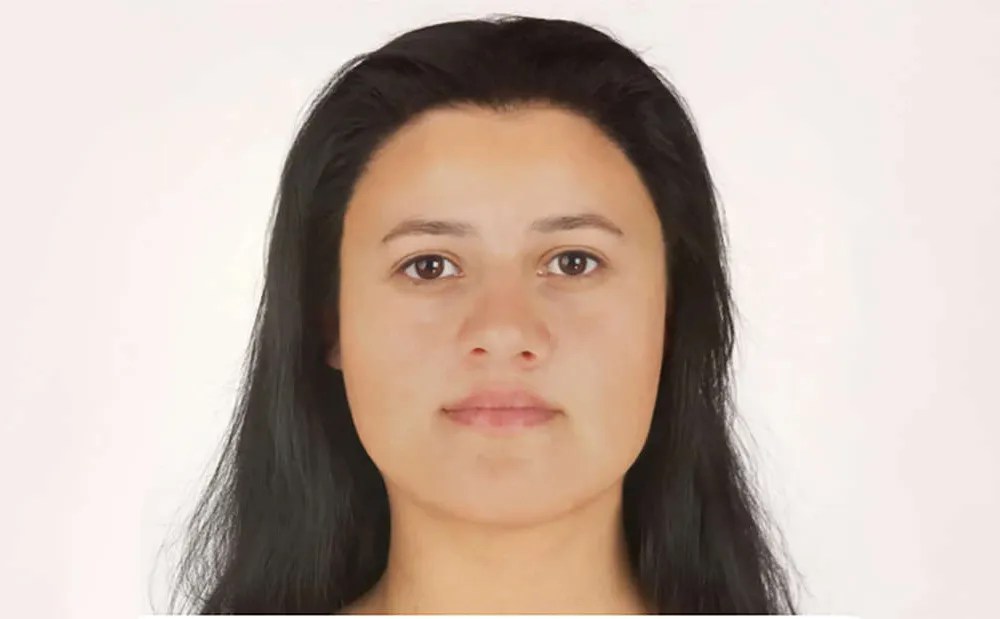
The young woman you see here is unique. Her name is “Ava” and she is from Scotland. The image represents her as she might have appeared as a 20-something. In reality, though, she is a bit older, 4,200 years or so. Her skull and bones were found in a carved-out stone depression near Achavanich in Caithness in 1987 (http://www.bbc.com/news/uk-scotland-highlands-islands-36923891). The story of her facial reconstruction by forensic anthropologists can be found at https://www.smithsonianmag.com/smart-news/no-wait-real-ava-bronze-age-woman-scottish-highlands-180970950/.
Using forensic techniques and image reconstructing software, researchers put muscle and skin on “Ava” to gain a likeness of how she may have looked. Measuring her skull dimensions, eye socket distance, mandible size, and other parameters and applying the average thickness of facial tissue to the underlying structures, we are presented with an approximation of this young woman as she may have appeared 4 thousand years ago.
What we need to understand is that this is an approximation. We don’t know her eye color. We can only guess as to her hair color and length and texture. But what we do have is the gaze of a woman from the past looking back at us and we to her. Science has given us a glimpse of a person from long ago. I think this image is amazing and haunting.
What this image cannot do, however, is answer several interesting questions. Sure, we have that gaze back from the screen, but what about what she thought during the last moments of her life? What did her voice sound like? What made her happy or sad? What made her laugh or cry? What songs did she sing? Did she think of the future? Did she dwell on the past?
These questions, science can never answer. To a scientist, these questions probably are unanswerable and so, not to be considered.
But you know, these questions and others like them, help us answer “What does it mean to be human?” We should look at Ava and recognize that not only is it she who is looking out at us, but all people through time.
 Curator's Desk