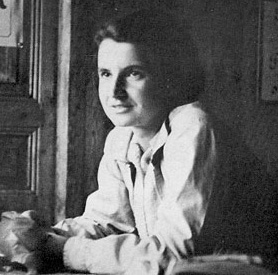
The young woman pictured above should be as well known as James Watson and Francis Crick, the discoverers of the structure of the DNA molecule. Watson and Crick, along with Maurice Wilkins received the 1962 Nobel Prize in Physiology or Medicine for their work in discovering the shape of that molecule.
Rosalind Franklin (Figure 1) was an X-ray crystallographer. Her research required exhaustive purification of certain chemical compounds and then subjecting them to X-rays. The resulting X-rays would then be recorded on a photographic plate. What would be seen, however, would be a pattern of light and dark areas on the photographic plate (see Figure 2) that indicated the shape of the molecule through which the rays passed, called a ‘diffraction pattern’. Through careful measurements of the patterns on the plate, the shape of the molecule could be determined.
Franklin received her PhD in 1945. From 1947 until 1950, she worked under Jacques Méring at the State Chemical Laboratory in Paris where she learned the techniques of X-ray diffraction photography. While in France, her work quickly made her an expert in X-ray crystallography. She moved back to London in 1951 where she continued her work in diffraction photography at the Biophysical Laboratory at King’s College. Her task at King’s College was to upgrade the X-ray crystallography lab there to work on DNA in the lab of Maurice Wilkins.
The work involved in producing the diffraction patterns was tedious and meticulous. This type of effort was just what the young woman’s mind excelled at. Her work, in early 1951 was getting samples of DNA pure enough so that the X-ray diffraction pattern could be analyzed and the structure of DNA could be discerned.

Figure 2: X-ray diffraction pattern of DNA. Photo 51 (2)
Her work slowly approached producing an image that would clearly demonstrate the helical (spiral) structure of the DNA molecule. Many people hypothesized that the DNA molecule might have a helical shape, but the manner of the molecule’s interlocking structural units eluded hard physical evidence. She still needed to measure and compute from the images she made, the data that would prove a helical shape. One of the best photos of the DNA molecule she produced was “Photo 51” (see above). She could see that the structure was helical, but she still held back and would not “go on the record” saying that DNA had a helical structure without further evidence.
Meanwhile, Watson and Crick, working at the Cavendish Lab of Cambridge University, were also trying to figure out DNA’s structure. Where Franklin was detail-oriented, Watson was more a theorist, who plunged headlong into problem-solving, theorizing many possible scenarios where interlocking sub-components of the molecule would fit together. He was familiar with being able to read diffraction patterns, but never produced any himself. One day, while visiting King’s College, he gained a look at Franklin’s work, without her permission, and this was enough for the theorist to recognize the path needed to build a model of DNA.
On 28 February 1953, Watson and Crick announced to the world that they had produced a 3-dimensional structure of the DNA molecule. The model was elegant in the manner of the molecular units of nucleic acids, of which there were four, and how they combined with a sugar-phosphate backbone.

Figure 3: Watson (left) and Crick demonstrate the DNA structure model (3)
In 1962, the Karolinska Institutet in Sweden awarded the Nobel Prize in Physiology or Medicine to Francis Crick, James Watson, and Maurice Wilkins.
For her work in providing the hard evidence for DNA’s structure, Franklin was not included in the award. There were several reasons given, one was that the Nobel rules specify that there is a maximum of three individuals who can be nominated for any of the awards.
Another reason was that the Nobel rules do not allow the prize to be given posthumously. Franklin died on 16 April 1958 from cancer. She was 37 years old.
In a field that is dominated by males, science needs to include the stories not only of men but also of the women who have moved human knowledge forward. Franklin is one of many.
(1) Science History Institute, https://sciencehistory.org/education/scientific-biographies/james-watson-francis-crick-maurice-wilkins-and-rosalind-franklin/
18 Feb 2024
(2) The Double Helix and the Wronged Heroine, https://www.nature.com/articles/nature01399#Fig1.
18 Feb 2024
(3) Science History Institute, https://sciencehistory.org/education/scientific-biographies/james-watson-francis-crick-maurice-wilkins-and-rosalind-franklin/
18 Feb 2024


 Curator's Desk