Oklahoma’s Fort Reno Remount Station
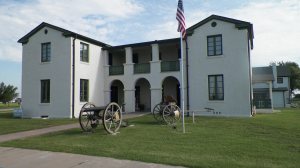
On our 2019 cross-country trip, following as much of the old Route 66 as we could find, we found the old Fort Reno Remount Station, not far from the old Route 66 and Interstate 40. Not knowing what to expect, we turned right onto the access road leading to the fort. That turn brought together several significant events in US history!
Established in 1874 as a military camp “to pacify and protect” the Cheyennes and Arapahos living in the area, the facility’s commanding officer designated the land along the south branch of the North Canadian River as the location for the future fort.
Military units of the 9th and 10th Cavalry and the 24th and 25th US infantry, the “Buffalo Soldiers” as the black soldiers were called by the Native Americans were assigned responsibility for peacekeeping in the region. The fort was important in transitioning the Oklahoma territory to eventual statehood in 1907.
Once the land was “pacified and protected”, it became open for settlement. Several of the Oklahoma land rush of the 1880s and 1890s had their beginnings at Fort Reno. Members of the Arapaho and Cheyenne tribes were given land allotments. Any excess land available was set aside for settlement. Prospective land settlers gathered along a “starting line” along the 89th meridian around Fort Reno, waiting for the cannon and pistol signals to dash as fast as they could ride horse and wagon to claim their land parcels. These areas are now parts of the metropolitan Oklahoma City!
In 1908, the US Army established three Quartermaster remount stations to provide horses and mules that provided transport of the materials needed. Fort Reno was one of these three. While mechanical trucks could haul more food, equipment, ammunition, and firearms, there were few of them available as were the parts needed for repair and maintenance. The needed roads were unimproved and in rainy seasons were difficult to pass. Horses and mules were more reliable. These remount stations provided the necessary horses and their training for use during World Wars I and II. Fort Reno had a detachment of “Fort Reno Remount Cowboys”, real cowboys who broke and trained the horses and mules!
One of the most famous horses bred and trained at Fort Reno was “Black Jack”. Black Jack was used in ceremonial parades, specifically funerals of military and presidential details where the horse would be outfitted with a saddle with backward pointed boots in the stirrups. Black Jack walked in the funeral processions of presidents Herbert Hoover, John F. Kennedy, Lyndon B. Johnson, and General Douglas McArthur and over 1,000 soldiers killed in action from the Korean and Vietnam wars.
During World War II, Fort Reno became a prison camp for over 1,300 captured German and Italian soldiers of Rommel’s Afrika Corps. The soldiers were hired out to local farmers for work details. In 1944, the soldiers constructed the Post Chapel on the grounds.
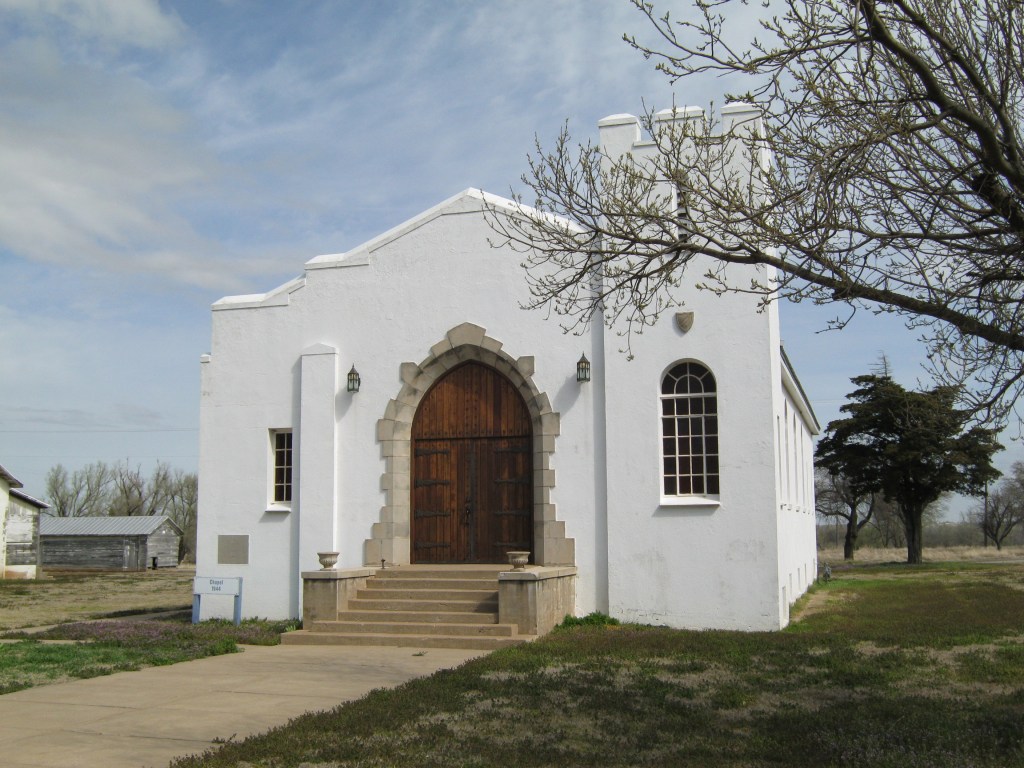
There is a prisoner cemetery located at the Fort. Sixty-two German and eight Italian soldiers who died at other prison camps in Texas and Oklahoma are buried there. Only one German prisoner who was kept there died at Fort Reno. Over the years after the war, families of those buried at Fort Reno have made visits to the cemetery to honor their loved ones.
The last military use of Fort Reno was in 1949 when the fort was turned back to the government. The land now is operated as a research facility by the US Department of Agriculture.
Early History of Fort Reno1
- Citation for Additional Infomation:
Early History of Fort Reno
http://www.fortreno.org/history-2/ ↩︎
 Curator's Desk