Oklahoma’s Fort Reno’s Role in History

Oklahoma’s Fort Reno Remount Station
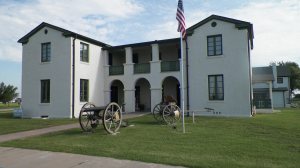
Original Fort Reno main building and now the visitor’s center.

On our 2019 cross-country trip, following as much of the old Route 66 as we could find, we found the old Fort Reno Remount Station, not far from the old Route 66 and Interstate 40. Not knowing what to expect, we turned right onto the access road leading to the fort. That turn brought together several significant events in US history!

Established in 1874 as a military camp “to pacify and protect” the Cheyennes and Arapahos living in the area, the facility’s commanding officer designated the land along the south branch of the North Canadian River as the location for the future fort.

Military units of the 9th and 10th Cavalry and the 24th and 25th US infantry, the “Buffalo Soldiers” as the black soldiers were called by the Native Americans were assigned responsibility for peacekeeping in the region. The fort was important in transitioning the Oklahoma territory to eventual statehood in 1907.

Once the land was “pacified and protected”, it became open for settlement. Several of the Oklahoma land rush of the 1880s and 1890s had their beginnings at Fort Reno. Members of the Arapaho and Cheyenne tribes were given land allotments. Any excess land available was set aside for settlement. Prospective land settlers gathered along a “starting line” along the 89th meridian around Fort Reno, waiting for the cannon and pistol signals to dash as fast as they could ride horse and wagon to claim their land parcels. These areas are now parts of the metropolitan Oklahoma City!

In 1908, the US Army established three Quartermaster remount stations to provide horses and mules that provided transport of the materials needed. Fort Reno was one of these three. While mechanical trucks could haul more food, equipment, ammunition, and firearms, there were few of them available as were the parts needed for repair and maintenance. The needed roads were unimproved and in rainy seasons were difficult to pass. Horses and mules were more reliable. These remount stations provided the necessary horses and their training for use during World Wars I and II. Fort Reno had a detachment of “Fort Reno Remount Cowboys”, real cowboys who broke and trained the horses and mules!

One of the most famous horses bred and trained at Fort Reno was “Black Jack”. Black Jack was used in ceremonial parades, specifically funerals of military and presidential details where the horse would be outfitted with a saddle with backward pointed boots in the stirrups. Black Jack walked in the funeral processions of presidents Herbert Hoover, John F. Kennedy, Lyndon B. Johnson, and General Douglas McArthur and over 1,000 soldiers killed in action from the Korean and Vietnam wars.

During World War II, Fort Reno became a prison camp for over 1,300 captured German and Italian soldiers of Rommel’s Afrika Corps. The soldiers were hired out to local farmers for work details. In 1944, the soldiers constructed the Post Chapel on the grounds.
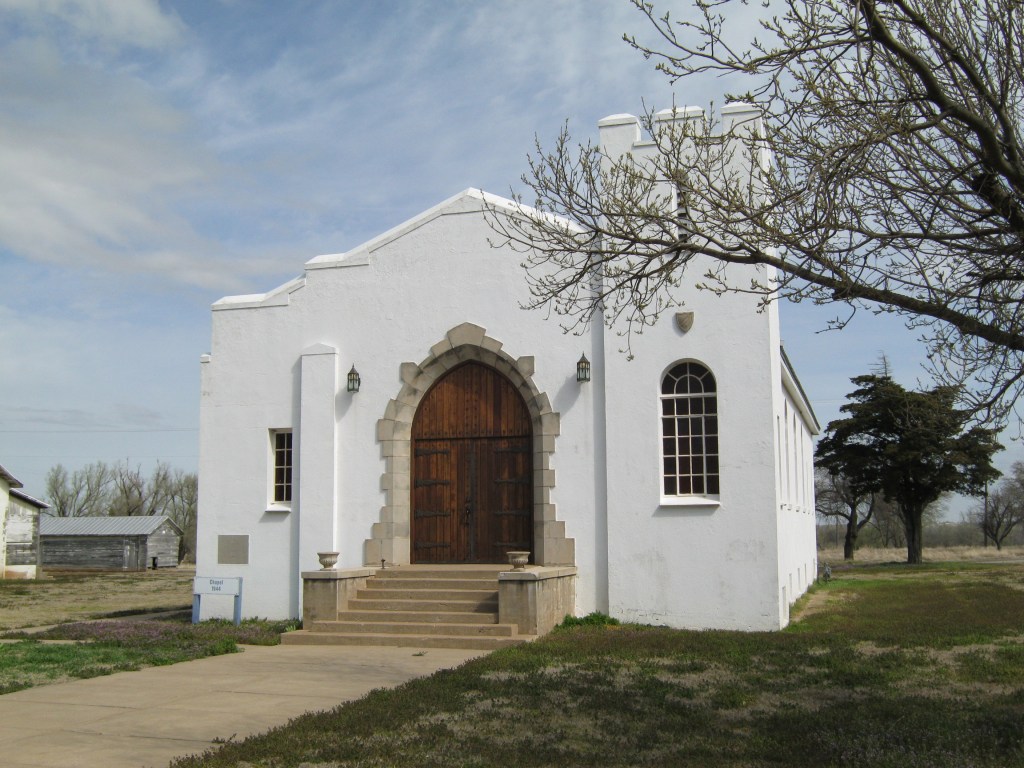
Post Chapel built by German and Italian WW2 prisoners.

There is a prisoner cemetery located at the Fort. Sixty-two German and eight Italian soldiers who died at other prison camps in Texas and Oklahoma are buried there. Only one German prisoner who was kept there died at Fort Reno. Over the years after the war, families of those buried at Fort Reno have made visits to the cemetery to honor their loved ones.

The last military use of Fort Reno was in 1949 when the fort was turned back to the government. The land now is operated as a research facility by the US Department of Agriculture.

Early History of Fort Reno1

  1. Citation for Additional Infomation:
    Early History of Fort Reno
    http://www.fortreno.org/history-2/ ↩︎

Whales in Central Texas!

This is a story of a trip Mary and I made one summer to Bandera, Texas about 18 years ago. The central Texas town, about an hour northwest of San Antonio, is in the Texas Hill country of the Edward’s Plateau. The town calls itself the “Cowboy Capital of the World”. where the last cattle drives of the late 1800s staged their start. It also claims the “Cowboy Capital” because many of the rodeo circuit performers call the area around Bandera home.

One morning, we set out for a daylong exploration trip north of Bandera. Rather than stopping for a restaurant breakfast, we drove to a local doughnut shop not too far from the center of town. We decided to get egg and sausage sandwiches and coffee. The shop was located in a storefront of a strip mall along the west road out of town. Pulling into the shop’s parking lot, we arrived at the same time as a rather beat-up old sedan. Inside were an old man and a woman driver. His companion helped him get out of the car and to the entrance. The old man obviously needed the help when he got out of the car, holding her arm and hobbling along. I held the door for them, noticing his swollen feet. He had socks on but no shoes or sandals, his feet too misshapen to accommodate such coverings. His hair was gray and straggling and long, as was his beard. He hobbled over to a table by the door and sat, relieved that the journey from car to table was over.

After placing our order, we sat at a table near the couple. While our order was being prepped, the old man looked at me and then at my school ring and asked “Is that a Texas A&M ring?” I said no, it was from a college in New England. He nodded and told me that it looked like it was. We exchanged a few more pleasantries and I told him that I did attend Texas Tech University a long time ago. He sort of smiled and chuckled that only two good things came out of Tech: oil engineers and Buddy Holly.

“So, what did you study at Tech?” he asked.

“Museum Sciences with a specialty in biology. It was difficult to find a museum job after graduation, so I eventually became a high school biology teacher.”

“I was in biology, too” he responded, “but jobs were scarce for anyone without a doctorate. So I got into wildlife biology. I enjoyed working with mammals.”

With this, this old man’s stories got very interesting. He worked for a while in Georgia as a wildlife biologist. “It was being outside in the sun and the weather. Those years, I couldn’t sit still in an office.”

I don’t know how we got onto the subject, but he also thought that whales were very special. “There was a lot of whaling going in up there a long time ago” he offered, referring to the 19th-century New England whaling industry.

“Yup, Cape Cod and the Islands, eastern Massachusetts, also Rhode Island and along the Connecticut shore,” I agreed.

“What about New Hampshire?” he asked.

“No, not there, the coastline is only about 13 miles long,” added Mary.

“There was that famous whaling ship, the Charles Morgan”, he mentioned. “That’s in Connecticut, right? I visited that ship once. I was amazed at the ship. Its size and how it would hold all that whale oil and all those people.”

I told him I once had a student who volunteered at a small boat-building workshop and museum in Amesbury, Mass where he helped build a replica of one of the whaleboats that went after those creatures. It took over a year to complete the boat, but once it was finished, the builders sailed it along the coast from Amesbury, down past Boston, through the Cape Cod Canal, and on to Mystic Seaport in Connecticut so that it could added to the complement of the other whaleboats on the Charles Morgan.

“Those little boats were something. They weighed about a thousand pounds and had a crew of at least 6 men. They also carried a mile or more of rope. That rope was made of hemp. Really strong stuff, that hemp.” The old man’s eyes lit up when he talked about all he knew of whaling.

“What was the longest time a whaling ship was out looking for whales?” he asked me. When I told him three or so years ago, he corrected me. “Nope, eleven years! Can you imagine being away from home for that long a time? When you come back, your children are all grown.”

We talked for a bit more. I was so thrilled to hear this old-timer share his stories and memories. It goes to show that not all first impressions should be believed. That old man and I shared a love of biology and telling stories. For a short time, the time it takes to prep and eat a sandwich, it’s possible to share a friendship.

                                        7 February 2024