By Steve Sousa
“King Philip Came Over For Good Spaghetti” is a mnemonic device I learned in my high school biology days. The initial letter in each word represents the name of the organizing level in the Linnaean system of classifying organisms: (K)ingdom, (P)hylum, (C)lass, (O)rder, (F)amily, (G)enus, and (S)pecies. Each step down from Kingdom becomes more specific in describing particular types of organisms, where all the members of that step share some similar characteristics. This month I’d like to focus on a particular Order of Insects, the Odonata whose members include damselflies and dragonflies. As a kid, these “bugs” scared me and my friends. Their huge eyes and long sideways wings gave them a prehistoric look and kid anecdotes report that they sewed up your lips or gave you painful bites. When encountered, they were given a wide radius!
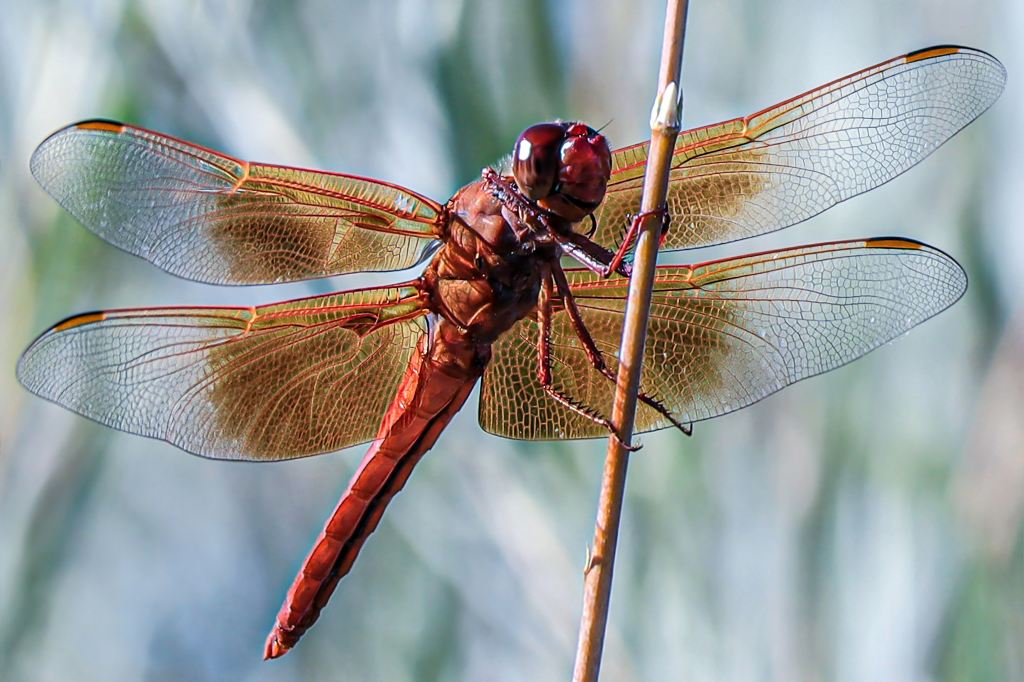
The Odonata order first appears in the fossil record during the late Carboniferous Period, a bit more than 300 million years ago, about 100 million years before the dinosaurs! It was during this time that the great coal deposits found in Europe and North America were put down. The environment during this time of Earth’s history was more humid and tropical, and had a somewhat uniform climate. Many of the plants and animals we recognize today had their origins during this period.
The damselflies and dragonflies we see today possess some structural similarities: they have two pairs of long, transparent wings that for the damselflies fold together above their body, while for dragonflies, their wings remain outstretched to the sides of their body, like airplane wings. The central thorax is large, roundish and is where the legs and wings attach. The abdomen is usually longer than the length of the wings. They are voracious predators of aquatic and terrestrial bugs and even small fish.
Dragonflies and damselflies begin life as eggs laid in or near water. The hatchlings, called nymphs, are aquatic, feeding on mosquito larvae and other small critters sharing the pond with them. After a period of weeks to several years, depending upon the species, the nymph will crawl onto a plant stalk to molt from their ‘skin’ into the flying adult stage.
The adults are extraordinary fliers. The large eyes provide them with excellent vision and the two pair of wings give them acrobatic maneuverability in flight. They are able to catch other flying insects on the wing. They are a great consumer of mosquitoes. It is a good idea to protect streams and ponds near your property to encourage them to hunt in your backyard!
There are nine Families of odonates that can be found here in New Hampshire, three families of damselflies and six families of dragonflies. For the damselflies, there are the Broad-winged Damsels (family Calopterygidae), the Spreadwings (family Lestidae), and the Pond Damsels (family Coenagrionidae). The six families of dragonflies are the Darners (family Aeshnidae), the Clubtails (family Gomphidae), the Spiketails (family Cordulegastridae), the Cruisers (family Macromiidae), the Emeralds (family Cordulidae), and the Skimmers (family Libellulidae).
Age and knowledge have tempered the uneasiness I used to feel about these critters. They perform a variety of important ‘ecosystem services’ (activities that make a positive contribution to nature and ourselves). For example, they feed on bugs that feed on me. Doing so, they reduce the number of mosquitoes in an area. This means less need for pesticides. One action you could do to help these marvelous creatures: when visiting streams and ponds, don’t pile up stones together; the undersides of the stones provide places to lay eggs. Placing the stones out of the water disturbs their lifecycles!
During the summer in my backyard, I’ve seen them congregate in large numbers. They are going after small flying insects coming out of the ground from their seasonal lifecycle. There are so many dragons that my yard looks like a miniature airport, the mini dragons zipping back and forth, changing direction instantaneously as they hunt their prey.
I now take joy in having these ‘dragons’ visit my yard. I love pointing out their behaviors to our grandchildren, hoping that they will not fear having their mouths sewn shut and find amazement in seeing a group of critters whose origins are so long ago in the past.
This article originally appeared in the August edition of “What’s Happening?” the newsletter of the Kingston (NH) Historical Museum.
 Curator's Desk